
Anna says...
AL
Anna L.Ophthalmologist
A seven-module masterclass for ophthalmologists who want to manage glaucoma the way Volodymyr Melnyk does — from pathogenetic logic and gonioscopy through to classical surgery, MIGS, and real clinical cases with their complications.
Glaucoma PRO is a seven-module clinical masterclass on glaucoma management by Volodymyr Melnyk, MD, PhD — Founder and Medical Director of VISIOBUD Clinic, Head of the NGO «Union of Ukrainian Ophthalmic Surgeons» and member of the ESCRS Glaucoma Committee. The course walks from definition, ocular hydrodynamics and pathogenesis through diagnostic strategy and gonioscopy, on to pathogenetic selection of medical treatment, classical surgical techniques including the author's own modified tunnel trabeculopuncture and capsular triangle drainage stent, MIGS in real practice, and a final set of four real clinical cases. Built around 3,000+ eye operations a year and authored techniques — practical decisions for everyday ophthalmology, not generalised theory.
Apply the WHO-based optic-neuropathy definition and the tolerant vs intolerant IOP concept when assessing a glaucoma diagnosis.
Implement a structured monitoring plan with the 25% rule, target IOP and the four-group surgical indication framework.
Differentiate angle width grades, pigmentation grades and Schlemm's canal signs in everyday gonioscopic examination.
Choose between drops, SLT and surgery based on anterior vs posterior chamber pathogenesis rather than IOP number alone.
Recognise indications, surgical steps and complication management for DNPS, trabeculectomy, drainage devices and the author's own techniques.
Position MIGS devices (iStent, Hydrus, GATT, XEN) honestly against classical surgery limits and industry claims.
Glaucoma is not a diagnosis on the IOP number — it is an optic neuropathy under intolerant pressure. A walk through the WHO definition, the tolerant vs intolerant IOP concept, what is wrong with the classical A/B/C classification, ocular hydrodynamics from Pascal to Bernoulli, and the three theories of optic nerve damage. The foundation for every clinical decision that follows.
Working with a glaucoma patient is not about the prescription — it is about persuading them to actually take it for life. A practical model for diagnostic strategy, monitoring schedules, target vs tolerant IOP, four groups of surgical indications, the 25% rule, and how to communicate the diagnosis differently than you do for cataract.
Gonioscopy remains the gold standard — and most of us do it too rarely or too quickly. A detailed tour of the anterior chamber angle: Goldmann vs van Beuningen lenses, anatomical landmarks, four width grades, five pigmentation grades, Schlemm's canal sclerosis, post-surgical changes, congenital and juvenile dysgenesis — with a live demonstration and an honest look at OCT-AC vs gonioscopy.
If you choose treatment by the IOP number alone, you will lose half your patients. The pathogenetic logic — anterior chamber vs posterior chamber type — drives the entire decision tree: drops, SLT or surgery. A walk through hydrodynamics, the prostaglandin era after Xalatan, tactical vs strategic effects of drugs, the practical drop algorithm and the surgical hierarchy.
What actually happens between conjunctiva and Schlemm's canal — and how the smallest decisions on flap design and Mitomycin C application change the outcome. Step-by-step through deep non-penetrating sclerectomy and trabeculectomy as the gold standard, the author's own modified tunnel trabeculopuncture, anterior lens capsule used as a biological drainage stent, suprachoroidal AJL, Express Shunt and Ahmed Valve — with complication management throughout.
MIGS was sold as making glaucoma surgery accessible to everyone — but is it really? An honest look at Ike Ahmed's philosophy and the ESCRS Barcelona debate, the MIGS classification by mechanism, what iStent, Hydrus, GATT, CyPass and XEN actually deliver, industry bias in conference presentations, and where MIGS sits in the real surgical hierarchy.
Four real cases where the decision was not obvious. A 52-year-old on Latanoprost who didn't actually need it; pseudoexfoliative glaucoma on thin sclera; advanced damage with IOP 37 and how to enter the eye safely; a complex multi-revision patient with Ahmed Valve and expulsive complications. Every case ends with the lesson the author took from it.
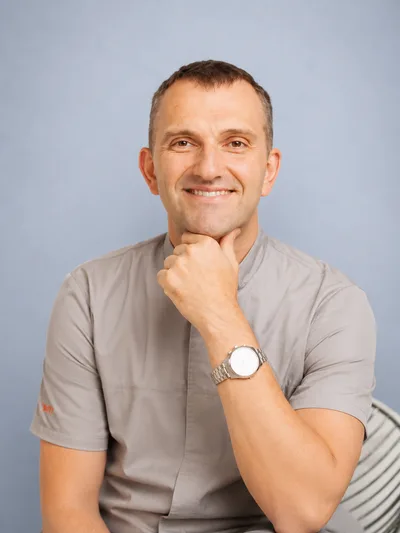
Ophthalmic surgeon of the highest category and Candidate of Medical Sciences (PhD). Founder and Medical Director of the Visiobud-Plus modern ophthalmology clinic and Head of the NGO “Union of Ukrainian Ophthalmic Surgeons”. He specializes in cataract, glaucoma and retinal surgery, performing around 3,000 eye operations a year. Member of the European Society of Cataract and Refractive Surgeons (ESCRS) and of the ESCRS Glaucoma Committee.
Author of the course "Glaucoma PRO: practical approaches to diagnosis and treatment"
Educational use only. This program is provided by Sona Academy for educational and informational purposes for healthcare professionals and students only. It is not intended for patients or the general public, is not a substitute for professional medical advice, diagnosis or treatment, and is not intended to promote the use of any products.
Funding & editorial independence. The sponsor does not participate in or influence the selection, development or content of the program. The content is developed by the speaker, and the opinions expressed are the speaker's and do not necessarily reflect those of Sona Academy or the sponsor.
Jurisdictional differences. Laws, regulations and ethical standards governing medical practice vary by country, and not all methods or techniques presented may be permissible in every jurisdiction. Users are responsible for ensuring compliance with all laws, regulations, licensing requirements and professional standards applicable in their jurisdiction.
The speaker has declared no relevant conflicts of interest in relation to this presentation.


Tell us which topics matter most to You, which learning formats You prefer, and which speakers You would like to hear from. Complete the short survey and influence future educational initiatives of Sona Academy.
